







All chefs know that preparing the perfect chocolate mousse is one part science and one part art. ESA’s microgravity research is helping the food industry to understand the science behind the foams found in many types of food and drink, from coffee and meringues to marshmallows and beer. But not all foams are created equal. Consumers expect a chocolate mousse to keep its structure and taste on the journey from the supermarket to their fridge. But the froth on some drinks would seem strange if it did not disappear after a few minutes. Creating the right type of foam on demand can be tricky.
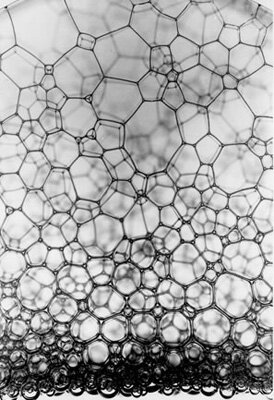
Image credit: NASA
AirZero-G flight to make a perfect foam
As shown on the picture, liquid flows downwards on Earth and as a result of this process foams are torn apart by gravity pulling on the bubbles. Foams are easier to study in weightlessness because the bubbles are evenly spread rather than the larger bubbles floating to the top.
The ESA’s parabolic flights are the solution for short-duration scientific and technological investigations outside Earth’s gravity. These flights are the easiest way to test microgravity with humans without needing to go all the way up to the International Space Station. Yet, creating foams in microgravity is not as straightforward as it might seem. Scientists are mainly familiar with how foams form on Earth. After some experiments, a design was found that uses electromagnetically powered pistons to whip the liquids into shape before the experiment was flown.
Nestle experiments on the parabolic flight
ESA has been investigating foams since the 1980s and the knowledge and know-how caught the attention of food company Nestlé over 10 years ago. “It seemed like a natural fit to work together with Nestlé since the ESA is already supporting research on foam technologies,” said Dr Olivier Minster, Physical Sciences Unit Head for the Human Spaceflight and Operations Directorate at the ESA.
The Nestle scientists were working on foam experiments designed to produce the ‘perfect’ bubble. Six samples of water and milk protein were placed in a machine that analyses the structure of foam, which was secured on board the ESA-sponsored Airbus A300. The plane made about 30 ‘roller-coaster’ parabolas which generated 20 seconds of microgravity at a time. Dr Cécile Gehin-Delval, scientists at the Nestlé Research Center in Switzerland, said:
“Gaining a better understanding of foam may help to improve the texture of our products. Stable foam in chocolate mousse gives the feeling of creaminess in the mouth. To make fine coffee froth, we want to create stable little bubbles to make it light and creamy.”