






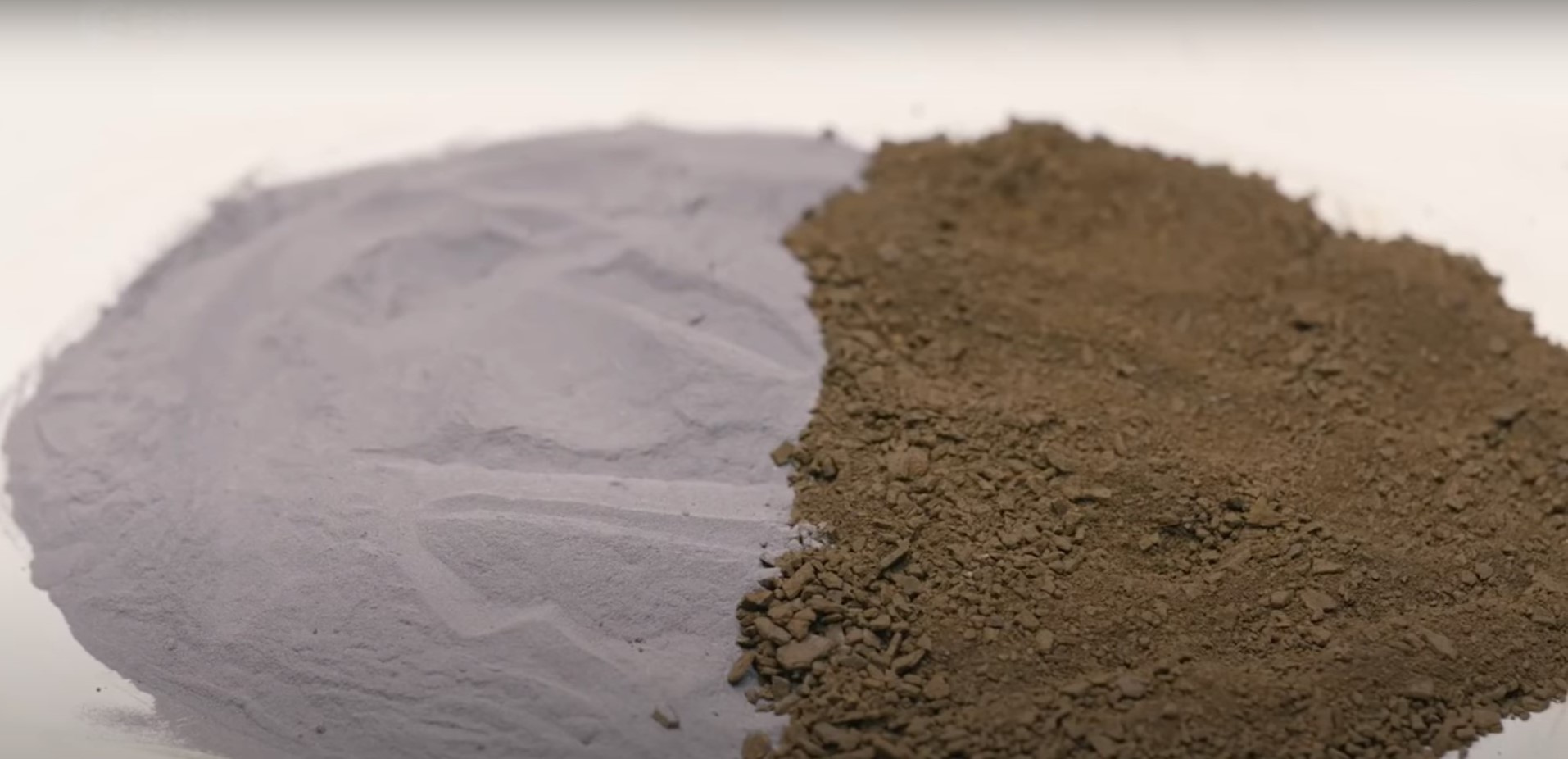
Did you know iron could burn? And that in microgravity we are preparing one of the most promising fuels for the future? The combustion of iron powder seen here is taking place on an entirely smokeless, carbon free basis.
Microgravity is helping to find answers and models to refine the processes needed to efficiently burn solid fuel like iron dust. Are we witnessing the rise of a new “Iron Age”? Could we use metal powders instead of petrol to fuel our cars? Solid fuels are used for burning a match, lighting a sparkler on New Year’s Eve as well as the fuel inside the boosters of Ariane and of other rockets. But metals such as iron can also burn, in powder form, and are entirely smokeless and carbon free.
Tested in microgravity aboard ESA sounding rockets by a team from McGill University in Canada and Eindhoven University of Technology in the Netherlands, this technique has now been harnessed by Swinkels Family Brewers in the Netherlands, helping to free their brewing process from reliance on fossil fuels.
“The best way to reduce carbon emissions into the atmosphere is not to emit it at all,” explains ESA engineer Antonio Verga, who worked on flying the team’s experiments aboard TEXUS sounding rockets.
“The basic idea of burning metal is hardly new, especially in the space field, because solid rockets rely on aluminium particles as fuel – burning many tons within a few minutes. But aluminium only burns with very tiny particles – iron is a more practical fuel for controlled combustion, while having a comparable energy density to gasoline.”
The combustion process works differently from ‘traditional’ carbon fires, with the burning process transferred between adjacent iron particles by heat radiation, akin to the way neighbouring trees catch aflame during a forest fire.
When we burn carbon and oxygen we produce carbon monoxide or dioxide, but if we burn iron in the place of carbon then no noxious gases are produced at all. Instead, the iron is oxidised – in plain language it rusts.
The idea comes from an inventive team of Canadian and Dutch researchers. The sounding rocket experiments allowed the iron particles to float free in weightlessness as they burned, helping the team evaluate the optimal size and density of particles and oxygen levels, to prevent the combustion either burning up too quickly or choking itself off.
“The Percolating Reaction–Diffusion Waves experiment, PERWAVES, supported by the Canadian Space Agency and ESA, studies the combustion of metal-particle suspensions in microgravity to investigate the physics of a new type of flame propagation regime. Understanding the physics of these metal flames is essential to designing flexible and efficient metal-power systems for carbon-free energy.” Jeffrey M. Bergthorson, Associate Professor at McGill University’s Department of Mechanical Engineering
Antonio adds: “By happy accident the optimal combustion particle size has been found to be in the range of 25-30 micrometres, which is close to those leftover from iron processing. The correct size can be obtained simply by sieving.”
In a vote of confidence for the technique a student team at TU Eindhoven worked with industrial partners to design the combustion facility now installed at Swinkels Family Brewers, subsidised by the Dutch province of Noord-Brabant, used to produce steam for the brewing process.
‘Together with student team SOLID and several industrial parties we scaled up the small-scale metal fuel flames of PERWAVES to the much larger size of 100 kilowatts to produce steam for the brewing process,” explains Philip de Goey Full Professor of Combustion Technology at TU Eindhoven. ”We are currently developing an even larger scale system of one megawatt and we are planning a five megawatts pilot peak boiler for the city of Rotterdam. In another demo-system, we are performing the reduction of rusted powder back to pure iro using green hydrogen. There are still many steps to be made, but our first results look promising.”
Follow-up PERWAVES sounding rockets are also scheduled, with the next ESA sounding rocket experiment due to fly in spring 2022.